Mobile Computer Services: Why is password manager software important?
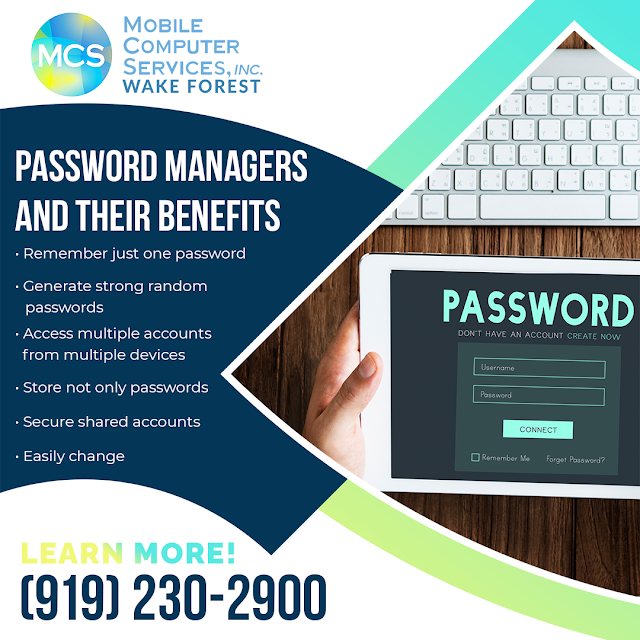
Password Managers and Their Benefits
The Internet is filled with password-protected applications and websites today. Be it for shopping, booking a cinema ticket, internet banking, or paying bills, most websites/applications require their users to create an account and secure it with a login name and password. Clearly, it becomes cumbersome for the user to remember individual username-password combinations for each of their accounts. As a result, many users tend to repeat the same passwords to access different sites. This practice makes it easy for hackers to hack into their various accounts and create problems. Mobile Computer Services, a managed IT company in Wake Forest, talks about the benefits of using password managers to generate and store passwords.
1. Remember Just One Password
A major benefit of using password managers is that it acts as a digital book that holds all the usernames and passwords of the user. Users have to remember just one master password to log in to their password manager application. Keep in mind that this master password should ideally be a strong and memorable passphraseso that the details are not compromised even in the event of a data breach of the password manager server.
2. Generate Strong Random Passwords
Password managers generate new passwords while creating new accounts on websites/ apps. These passwords will be strong and random and hence difficult to be cracked by a hacker algorithm.
3. Access Multiple Accounts From Multiple Devices
Password managers can be added as browser extensions. Users just have to log in to the password manager, which can autofill the login pages. The passwords are stored securely in the password manager.
Many password managers also allow access from multiple devices. As most people nowadays use their mobile devices to browse the internet, password managers must work across different devices and provide support for mobile app logins.
4. Store Not Only Passwords
Password managers are capable of storing data such as memberships, security questions, and profile details like name and phone number.
5. Secure Shared Accounts
Sometimes shared accounts are used by a team so multiple people can log in to the same account for certain tasks. Example: a shared social media account of a company. Password managers can be used to control who has access to such shared accounts.
Further, some password managers can allow one person to manage a shared account and control the access without revealing the actual password to other members.
6. Easily Change
In case of a hack or even otherwise, changing passwords of various accounts is quick and easy with password managers. The password generator can easily generate new strong passwords for the accounts without the user having to remember them all.
Why Mobile Computer Services?
Mobile Computer Services is a managed IT services company in Wake Forest, providing the complete package of IT Support, IT Consulting, Server IT Support, Network Services, Internet Security Services, Office Move Assistance, and Hardware as a Service for modern-day companies. MCS has an expert team that acts as your partner in security and guarantees decreased downtime and comprehensive and reliable network security.
Experience the most advanced defense against internet threats by contacting Mobile Computer Services, Inc. at Wake Forest now at (919) 230-2900.
The hybrid work model has gained popularity since the pandemic. In a hybrid work model, employees can work from both onsite and remote locations. Many companies have now adopted the hybrid work model where employees need to work from the office for a few days a week and the rest remotely. This flexible work model can improve the work-life balance for many, thereby increasing productivity and also bringing down business costs. It should be noted that the hybrid model poses challenges, such as the maintenance of IT devices that are spread across multiple locations. Mobile Computer Services, an IT services company in Wake Forest, explains how managed IT can help support the hybrid model better.
1. Remote IT support
Employee isolation is an issue faced by those working remotely. Remote employees may feel isolated when they have a technical IT issue, and there is no IT support at hand. Hence, it is necessary for the IT support team to be robust enough to reach all remotely working employees so that they feel included and their productivity is not affected.
2. Securing devices
In a hybrid work model, companies must ensure that all devices used by employees are secured with antivirus and anti-malware software. Also, all software updates and patches should be applied on time. It may be difficult for the company to keep track of all devices spread across different locations. A managed IT services company can help streamline such processes.
3. System maintenance
It may prove challenging for an in-house team to track all the different devices being used by remote employees and ensure that they are in good working condition. Sometimes, employees may even use their personal laptops for work. Hence, it is necessary to ascertain that these devices adhere to company policies and that they are all patched and regularly maintained so that productivity is not impacted. A managed IT company can help to eliminate these problems without the expense of hiring in-house IT staff.
4. Data backup and data security
In the case of a hybrid working model, it is essential to back up all data regularly, as employees are mostly on the move and not restricted to one work location. Further, a backup testing strategy should also be put in place to test the efficacy of the backups taken.
When remote employees handle a company’s sensitive data, IT support should ensure that security measures are in place so that the data is not compromised. Cybersecurity training and locked-down company devices can be given to such employees.
Clearly, the hybrid model requires IT support that provides 24/7 proactive management and monitoring of their IT infrastructure, and a good managed IT services company provides just that.
Why Mobile Computer Services?
Mobile Computer Services offers expert IT solutions to the client, guaranteeing peace of mind, less downtime, fewer disruptions, and predictable budgeting. A managed IT services company in Wake Forest, Mobile Computer Services works with small and medium businesses, providing IT solutions for requirements ranging from setting up new systems to maintaining existing systems, managing remote desktop support to onsite system support.
MCS’s IT consultants ensure that clients get the best technology available in the market, and that too for the best prices.
Get in touch with the managed IT services experts at Mobile Computer Services, Inc. at Wake Forest. Call today at (919) 230-2900.
Most people are aware of the need to regularly apply software updates and perform virus scans to keep their digital equipment, such as computers, clean. The hardware (and external parts) of the device must be also properly maintained and cleaned regularly. This helps to extend the lifespan of the device and also prevents malfunction. Mobile Computer Services, a managed IT company in Raleigh, explains the benefits of keeping computers and digital devices clean and dust free.
1. Use padded cases
It is very common for people to carry their laptops/ tablets wherever they go. Accidental jolts and bumps can damage the internal components of the laptop. Hence it is better to carry the laptop/tablets in a padded computer bag. Laptops must be shut down before they are put in the bag/sleeve, as a device that is left on can get overheated in a closed, tight space.
Mobile phones and tablets should be protected with screen guards and proactive cases. These accessories help to keep them scratch-free. Also, electronic gadgets should not be left near high heat sources such as kitchen stoves or heaters.
2. Organize cords
Power cords supply power to gadgets and hence are very important for the functioning of the gadget. Power cords should be neatly and loosely wrapped in a circle or the shape of the number eight while carrying them around. Winding the cords too tight can damage the wires inside them.
When the power cord is plugged into the device, it should be ensured that the cord is not placed along the common aisle/ path where people walk. A person tripping over the cord can topple the whole device onto the floor, causing irreversible damage. Cable clips are a good way to keep the cords organized. These can be clipped to desks, walls, or even floors and can hold a bunch of cables together. Colour coding and labeling of wires also help to avoid “cable spaghetti”.
3. Dust regularly
The outer parts of a computer should be regularly wiped with a microfiber cloth to remove dust. Also, it is best that eating and drinking are not done next to the computer. Coffee/ water being spilled on the keyboard is a very common cause of the malfunctioning of the machine. If something was spilled on the device, position it so that the liquid runs off, wipe it gently with a soft cloth and then leave it to dry. In case of a major spillage, the device should be taken to a repair shop. In any case, the device’s external case should not be opened by the user to dry the internal components. Opening the case can void the warranty of the machine.
It is always a good idea to get a thorough cleaning done once a year at an authorized service center.
4. UV Sanitization
UV sanitizers help to reduce germs on mobile phones and other gadgets. These sanitizers use Ultra Violet rays to destroy germs and have become quite popular since the pandemic.
Why Mobile Computer Services?
Mobile Computer Services offers expert IT consulting and services without undermining customers’ budgets. A managed IT services company in Raleigh, Mobile Computer Services is a one-stop shop for all IT services, whether it is to set up new systems or maintain existing systems. MCS ensures that customers do not have to compromise between affordability and reliability while providing them with peace of mind, less downtime, fewer disruptions, and predictable budgeting.
Stay ahead and stay relaxed with the managed IT services offered by Mobile Computer Services, Inc. at Raleigh. Call today at (919) 830-9448.
Dental practices, veterinary clinics, and small businesses must keep their guard up in the effort to maintain cybersecurity. Vulnerabilities can spell disaster. IT managed services are a burden that most small businesses are unable to shoulder alone. An outsourced managed IT solutions provider, such as Mobile Computer Services, Inc. of Wake Forest, is an affordable way to gain the cybersecurity every business needs to stay safe and functional in the “new normal” of accelerated cybercriminal activity.
Four types of phishing pose a critical threat to dental practices, veterinary clinics, and small businesses:
Spear phishing
Clone phishing
Whaling
Pop-up phishing
Spear phishing
The majority of phishing emails targets large groups of people. Spear phishing is a type of attack that is more personalized and individual in its approach and focus.
A spear-phishing email, as the name implies, targets a specific individual, business, or organization. Dental practices and veterinary clinics are prime examples of entities that this variety of phishing expedition would single out. The scammers who spear phish invest time to research their niche targets. This more sophisticated phishing is sometimes referred to as social engineering. The emails are configured to closely resemble legitimate sources.
In 2016, millions of Amazon customers received an email containing the same subject line message about an order status with an order code following directly after it. Upon opening the email, consumers found no message, only an attachment. Customers who opened the attachment put themselves or their companies at risk of installing ransomware on their computers or other devices.
Another example of spear phishing emails specifically involves small businesses, including dental practices and veterinary clinics. The target, in this instance, might be a company employee. The email may seem to originate from higher up the management chain, and it requests access to sensitive company information. If the spear-phishing target responds, a data breach could ensue in which company or employee information is accessed and stolen.
Clone phishing
Another type of malicious phishing, clone phishing, is very difficult to detect. This phishing attack involves creating a version of an email that victims have already received. The email address is very close to the address of the original email, and the formatting of the body of the email resembles the original email, as well. The only difference is the attachment or link in the message has been changed. Unwary victims who click on the link or open the attachment will be taken to a fake website or open an infected attachment. This type of email phishing requires a keen eye and attention to detail to notice.
Whaling
Some phishing expeditions focus on the large catch, the whales. Whaling attacks target chief executive officers, chief operating officers, or other high-level executives in a business. The phisher’s aim is to con these powerful individuals into divulging sensitive corporate information. Any key decision-maker with sensitive information qualifies as a high-value target, including dentists and veterinarians, as well as other small business owners.
These attacks require a higher level of sophistication and much more research. The scheme usually relies on fraudulent emails that seem to originate from trusted colleagues within the company or from legitimate external agencies.
Pop-up phishing
Pop-up phishing utilizes pop-up ads to entice users into installing malware on their computers. The ads may seek to convince the recipient to purchase unnecessary antivirus protection. Scare tactics may be employed. The user might be warned that their computer has been infected with a virus and the only remedy is to install a particular antivirus software. Upon installation, the user discovers this software is non-functional. Sometimes the supposed remedy actually infects the computer with malware.
How can a dental practice, veterinary clinic, or small business protect against a phishing attack?
Small businesses can take simple, common sense, proactive steps to avoid being scammed by phishing expeditions. The application of several commonsense principles and a healthy dose of suspicion are a good combination when dealing with potential cybercrimes. Cybercriminals are smart. Their subtle machinations can hook the most astute business owner or employee. The following principles will help safeguard against falling for the scammer’s tricks.
Delete suspicious emails.
Do not click on suspicious links in emails.
Do not send financial information through email.
Avoid clicking on pop-up ads. Hackers can add fraudulent messages that pop up when the victim is visiting legitimate websites.
Protect computers and other devices with strong, multi-layered security software.
Managed IT services are indispensable for cybersecurity in the twenty-first century. An outsourced IT support service is an affordable strategy to gain bullet-proof security and achieve peace of mind. For more information about IT solutions that work, contact Mobile Computer Services, Inc. of Wake Forest by phone at (919) 230-2900.
The COVID-19 pandemic has created subtle cybersecurity issues for small businesses. Mobile Computer Services, Inc. of Wake Forest provides cybersecurity advice on how to identify and avoid dangerous COVID-19 email phishing scams. The managed IT service providers build an email infrastructure that ensures a business can continue to utilize email as a safe and beneficial business tool.
A headline from The Wall Street Journal reads, “Don’t Click! Coronavirus Text and Phone Scams Are Designed to Trick You. Swindlers are taking advantage of the global health crisis, so watch out for email phishing, robocalls, and “smishing”—text-message scams sent to your phone.”
Billions of robocalls are annoying tens of millions of Americans. Unsuspecting and trusting individuals have shelled out vast sums of money to phone scammers and cybercriminals pretending to be government officials, health-care providers, IRS representatives, and more. As far as the robocalls, lawmakers find it all but impossible to make the calls stop. With the phishing (emails) and smishing (text messaging), commonsense strategies and IT managed email infrastructure security can address the cybersecurity issues.
The Wall Street Journal article begins with an all too common scenario. “A text comes in on your phone. It’s from the IRS, and your economic relief check is ready, pending your acceptance. There’s a form to fill out. All you have to do is click the link.”
With this introduction, author Nicole Nguyen brilliantly sets the stage for a straightforward solution that works every time. She writes, “If you don’t have time to read this whole column, please—for the love of sweatpants—just read this: Don’t Click The Link.”
The solution is not magical, nor is it an industry trade secret. Success at thwarting scammers does require some basic commonsense, self-discipline, and understanding of how to recognize fishy emails phishing for personal information.
News coverage in the dominant media culture surrounding COVID-19 has fostered phishing attacks seeking to exploit fears in the general population about the highly contagious and sometimes fatal virus.
How does the phishing scam work? Cybercriminals send bogus emails claiming to originate from legitimate organizations with vital data regarding COVID-19.
The email might direct the recipient to open a file attachment to read the latest statistics. Clicking on the file or embedded link may download malicious software onto the recipient’s device. The malicious software or malware enables cyber scammers to gain access to a computer, record keystrokes, or harvest personal information and financial data. Identity theft could be one of the painful consequences of this scam.
COVID-19 has impacted millions of lives worldwide. The long-term impact is impossible to predict. Effective steps are available to protect against COVID-related scams and mitigate the risk.
Spotting a coronavirus phishing email
Coronavirus-themed phishing emails appear in various forms, including the ones listed below.
CDC alerts
Cybercriminals are creating emails that appear to originate from the U.S. Centers for Disease Control. The email may claim to link to a list of local coronavirus cases. The recipient is urged to immediately read the cases and glean safety hazards to avoid. Warning: Avoid clicking on the links! Granted, the emails may look official. Stay safe. Visit the CDC website directly for COVID-19 information.
Emails giving advice on health issues
In these emails, scammers send offers of medical advice to help guard against COVID-19. The emails may purport to come from medical experts in Wuhan, China, the COVID-19 epicenter. The advice promises, “This little measure can save you!” Another scam strategy is “Use the link below to download Safety Measures.” Here is a simple, flawless cybersecurity safety measure: do not click on the link.
Workplace policy emails
This form of phishing scam deserves extra attention. Employees’ workplace email accounts are information-rich targets for cybercriminals. A sophisticated phishing email might open with the casual greeting, “All, Due to the pandemic outbreak of COVID-19, [company name] is actively taking safety precautions by instituting a Communicable Disease Management Policy.” Clicking on the fake company policy will download malicious software onto the device. The eventual legal and financial impact could destroy the company.
How to avoid scammers and phony ads
Scammers post ads claiming to offer COVID-19 remedies and use language that creates a sense of urgency. “Buy now, limited supply” is a prime example.
Responding to the ads could have several negative consequences.
Malware could be downloaded onto the device when a malicious link is clicked.
The product is purchased but turns out to be worthless.
Personal information such as name, address, and credit card number has been shared with a stranger who may use the information for identity theft or sell or trade the information to another cybercriminal who may use the information to cause mayhem in some person’s life.
A simple solution is to avoid any ads seeking to capitalize on the COVID-19 pandemic.
Tips to spot and avoid phishing emails
Follow these tips to spot and avoid pandemic-themed phishing emails.
Be very cautious of online requests for personal information.
A pandemic-themed email requesting personal information such as a Social Security number or login information is a phishing scam. Legitimate government agencies do not request information of such a personal nature. Do not provide personal data to such an email.
Verify the link or email address.
Hover the mouse button over the URL to inspect where the link leads. Sometimes, the website address is obviously fake. Scammers have become more sophisticated and will create links closely resembling a valid address. Take action if the ad is a scam and delete the email.
Keep an eye out for spelling and grammatical mistakes.
As mentioned above, phishers have perfected their messaging either by hard work or through artificial intelligence and grammar tools.
A generic greeting is a giveaway.
Phishing emails are unlikely to use the target’s name. Greetings like “Dear sir or madam” signal an email is not legitimate.
Avoid pushy emails insisting on fast action and little research.
The heightened sense of urgency or demand for instant action is to drive readers to respond in fear and click on a link to provide personal information. The simple, failsafe solution is to delete the message right now!
To learn more about IT managed solutions and email cybersecurity, visit the Mobile Computer Services, Inc. of Wake Forest website at www.ncmobilecomputerservices.com/locations/wake-forest. Contact the office by phone at (919) 230-2900.
The following article was originally seen on How to Spot COVID-19 Scam Emails and is republished from Mobile Computer Services, Inc. See more on: Mobile Computer Services, Inc.